
Pakistan Showcases Climate Leadership and Green Growth Vision at Global Climate Forum in Seoul
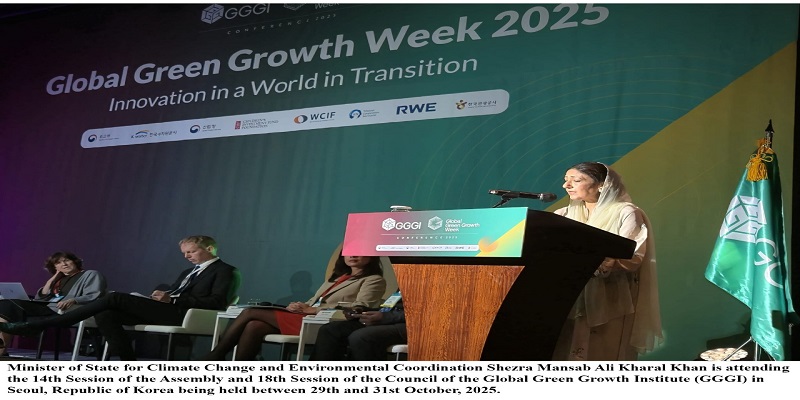
Seoul (October 31, 2025): Minister of State for Climate Change and Environmental Coordination Shezra Mansab Ali Khan Kharal reaffirmed Pakistan’s strong commitment to advancing global climate action, renewable energy transition and green growth for achieving global sustainability and climate resilience goals. Delivering a keynote address at the inaugural session titled “Implementing International Carbon Markets: Country Experiences and Strategic Pathways to 2030,” the Minister showcased Pakistan’s leadership role in developing low-carbon pathways and implementing climate-resilient policies. The event was attended by senior government officials from New Zealand, Norway, Sri Lanka, Senegal, Sweden, and Zambia, along with climate experts, NGO representatives, and media professionals. “Pakistan is among the top ten most climate-vulnerable countries in the world, despite contributing less than one percent to global greenhouse gas emissions,” the State Minister rShezra Mansab Ali Khan Kharal said in her keynote speech during the inaugural session. “Our glaciers are melting, our monsoon patterns are shifting, and our communities are paying the price of a crisis they did not create. Yet, we remain determined to lead through innovation, adaptation, and green growth.” She emphasised that Pakistan’s comprehensive National Climate Change Policy (NCCP) and National Adaptation Plan (NAP) serve as frameworks for translating international commitments into domestic climate action. Under these, Pakistan is strengthening climate resilience across sectors such as energy, water, and agriculture while mobilising climate finance and expanding partnerships with global institutions. “We are actively pursuing mechanisms under Article 6 of the Paris Agreement to operationalize international carbon markets,” she said. “This will not only help Pakistan attract investment and technology but also monetize our emission reduction efforts, particularly in renewable energy, reforestation, and sustainable agriculture.” The Minister acknowledged the Global Green Growth Institute’s vital role in supporting Pakistan’s transition toward a low-carbon economy through policy guidance, technical assistance, and capacity building. Pakistan has partnered with GGGI since 2017 to implement projects on green cities, waste-to-energy, and climate-smart infrastructure. She further noted that the Ministry of Climate Change and Environmental Coordination (MoCC&EC) is working closely with national and provincial stakeholders to scale up renewable energy projects, particularly in off-grid and climate-vulnerable regions. “Pakistan aims to achieve 60 percent renewable energy by 2030, in line with our Nationally Determined Contributions (NDCs),” she said. “This goal is not just about cutting emissions — it’s about ensuring affordable, reliable, and clean energy access for all Pakistanis.” On the sidelines of the Global Green Growth Week, Minister Kharal held bilateral meetings with the Government of Norway and representatives of international organizations to explore enhanced climate finance, technology transfer, and capacity-building support for Pakistan’s adaptation programmes, especially in regions like Gilgit-Baltistan, Swat, and Balochistan that face glacial melt, flash floods, and prolonged droughts. At a high-level panel discussion on “Water and Renewable Energy for Climate Resilience,” the Minister called for stronger global cooperation to integrate water management and renewable energy systems in national planning frameworks. “Climate change is exacerbating water insecurity and energy vulnerability, and Pakistan is already at the frontline of this crisis,” she said. “Our agriculture and industry depend on stable water resources, but glacial retreat and erratic rainfall patterns are disrupting this balance.” She explained that Pakistan is investing in solar-powered irrigation systems, micro-hydropower plants, and water-efficient agriculture technologies to build climate resilience and improve community livelihoods. “The water–energy nexus offers powerful solutions to reduce carbon footprints and promote inclusive growth. By integrating renewable energy with smart water management, we can protect both our ecosystems and our economy,” she added. The Minister also lauded GGGI’s partnership with Pakistan in advancing climate-smart agriculture, circular economy projects, and urban resilience initiatives in cities such as Lahore, Karachi, and Islamabad. She reaffirmed that Pakistan’s green growth vision aligns with the United Nations Sustainable Development Goals (SDGs) and the Paris Agreement targets. “For Pakistan, climate resilience is not optional — it is essential for our survival and future prosperity,” she stressed. “Our government is committed to ensuring that economic growth and environmental protection go hand in hand. We want to build a climate-resilient Pakistan that leaves no one behind.” The Global Green Growth Institute (GGGI) is an international organisation dedicated to promoting sustainable and inclusive economic growth by balancing development with environmental stewardship. Chaired by former UN Secretary General Ban Ki-moon, GGGI works with over 40 member countries to support the transition toward green economies, carbon neutrality, and climate-resilient development. Pakistan’s participation in the 2025 sessions underscores its growing engagement in global climate diplomacy and its ambition to position itself as a regional leader in green growth, renewable energy innovation, and carbon market development.
She made these remarks while addressing the 14th Session of the Assembly and 18th Session of the Council of the Global Green Growth Institute (GGGI) held in Seoul, Republic of Korea, from October 29 to 31, 2025, according to a press release issued here on Friday.
-----
For official communication or media-related inquiries, please contact: Muhammad Saleem Shaikh, Deputy Director (Media and Communication) Ministry of Climate Change and Environmental Coordination, Government of Pakistan at email: dd.media@mocc.gov.pk