
Federal Minister Dr Musadik Malik Urges Global Action at COP30 as HKH Glaciers Face Rapid Meltdown
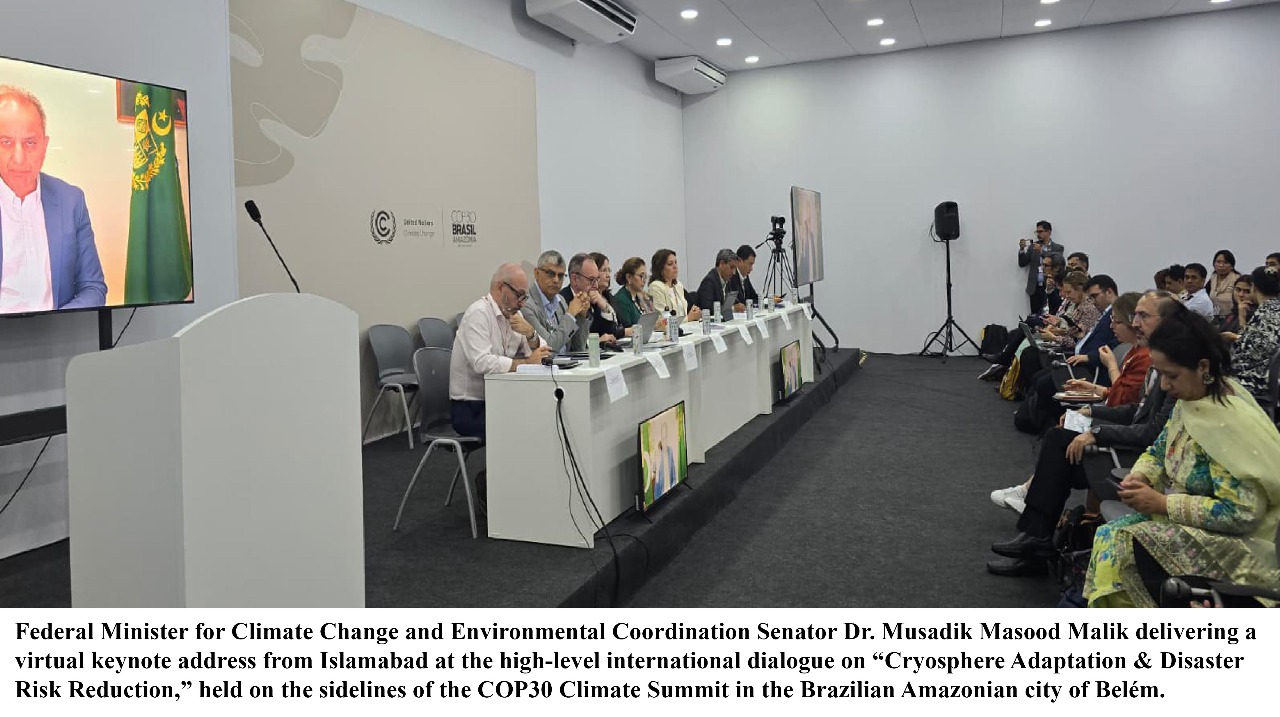
ISLAMABAD (November 16, 2025) Federal Minister for Climate Change and Environmental Coordination Senator Dr. Musadik Masood Malik warned that the world’s cryosphere is deteriorating at an unprecedented pace, placing billions at risk as the Hindu Kush–Karakoram–Himalaya (HKH) region faces accelerated glacier melt and climate-induced disasters, according to a press release issued here on Sunday from Ministry of Climate Change & Environmental Coordination. Addressing a high-level international dialogue at COP30 in the Brazilian Amazonian city of Belém through a keynote address delivered virtually from Islamabad, the Minister said that rapidly melting glaciers, thawing permafrost and shrinking snow reserves across the world are triggering cascading risks to lives, livelihoods, water systems and global food security. Hosted by the Ministry of Climate Change and Environmental Coordination in collaboration with international partners, the dialogue titled “Cryosphere Adaptation & Disaster Risk Reduction” brought together senior representatives, scientists and experts from Pakistan, Nepal, Bhutan, Türkiye, Azerbaijan, UNDP, UNESCO and the Asian Development Bank. Dr Malik underscored that the global cryosphere consisting of glaciers, permafrost, snow cover, sea ice and polar ice sheets is undergoing rapid decline due to rising temperatures, with far-reaching consequences for hydrology, agriculture, coastal stability and disaster frequency. He stressed that the HKH region, the world’s “Third Pole”, is warming nearly twice as fast as the global average, threatening the planet’s largest freshwater reserve outside the polar regions. The Minister highlighted the severe and accelerating impacts of climate change on Pakistan’s own glaciers, noting that the country’s high mountain ranges are experiencing rapid glacial retreat, expanding glacial lakes and a sharp rise in Glacial Lake Outburst Floods (GLOFs). “Pakistan is living the reality of climate change every day. Our glaciers are melting faster than ever before, our mountain communities are on the frontlines of disaster and our national water security is under threat. We cannot wait for warnings to become catastrophes; the world must act now with urgency and justice,” he said. Dr Malik added that these changes are already altering the natural flow of the Indus River, damaging critical infrastructure, eroding agricultural lands, and heightening water insecurity for millions downstream. For Pakistan’s mountain communities, he said, climate change is “not a distant threat but a daily crisis undermining lives and livelihoods.” Scientific assessments presented during the session indicated that up to 65% of HKH glaciers could disappear by 2100 under high-emission scenarios. For Pakistan, which is home to 13,000 glaciers, the implications are more adverse, posing risk to agriculture, hydropower generation, food production and urban water supply. Participants noted that GLOF events have already destroyed homes, schools, roads, bridges and croplands across Gilgit-Baltistan and Khyber Pakhtunkhwa, pushing vulnerable households into cycles of poverty and displacement. Downstream, erratic river flows are reducing agricultural yields, affecting energy generation and intensifying water stress in major cities. Experts warned that shifts in the Indus water system are also impacting pastoralism, local tourism, biodiversity and the economic stability of entire regions. Officials and technical experts from Türkiye, Azerbaijan, Nepal, Bhutan and ICIMOD called for stronger regional frameworks for climate data-sharing, joint scientific research and unified risk assessment across the HKH region. They emphasised the need for community-based early warning systems, improved glacial lake monitoring, enhanced disaster-preparedness training and targeted investment to strengthen local institutions. Representatives from UNDP, UNESCO and the Asian Development Bank reaffirmed support for Pakistan and HKH countries in advancing glacier resilience, ecosystem protection and disaster-risk reduction. The dialogue concluded with a strong collective call for enhanced regional cooperation, predictable and accessible climate finance, and urgent international attention to safeguard the fragile HKH cryosphere and protect the millions whose lives depend on it.
-----
For official communication or media-related inquiries, please contact: Muhammad Saleem Shaikh, Deputy Director (Media and Communication) Ministry of Climate Change and Environmental Coordination, Government of Pakistan at email: dd.media@mocc.gov.pk