
Pakistan Ramps Up Climate Preparedness with 300-Day National Plan, Says Musadik Malik
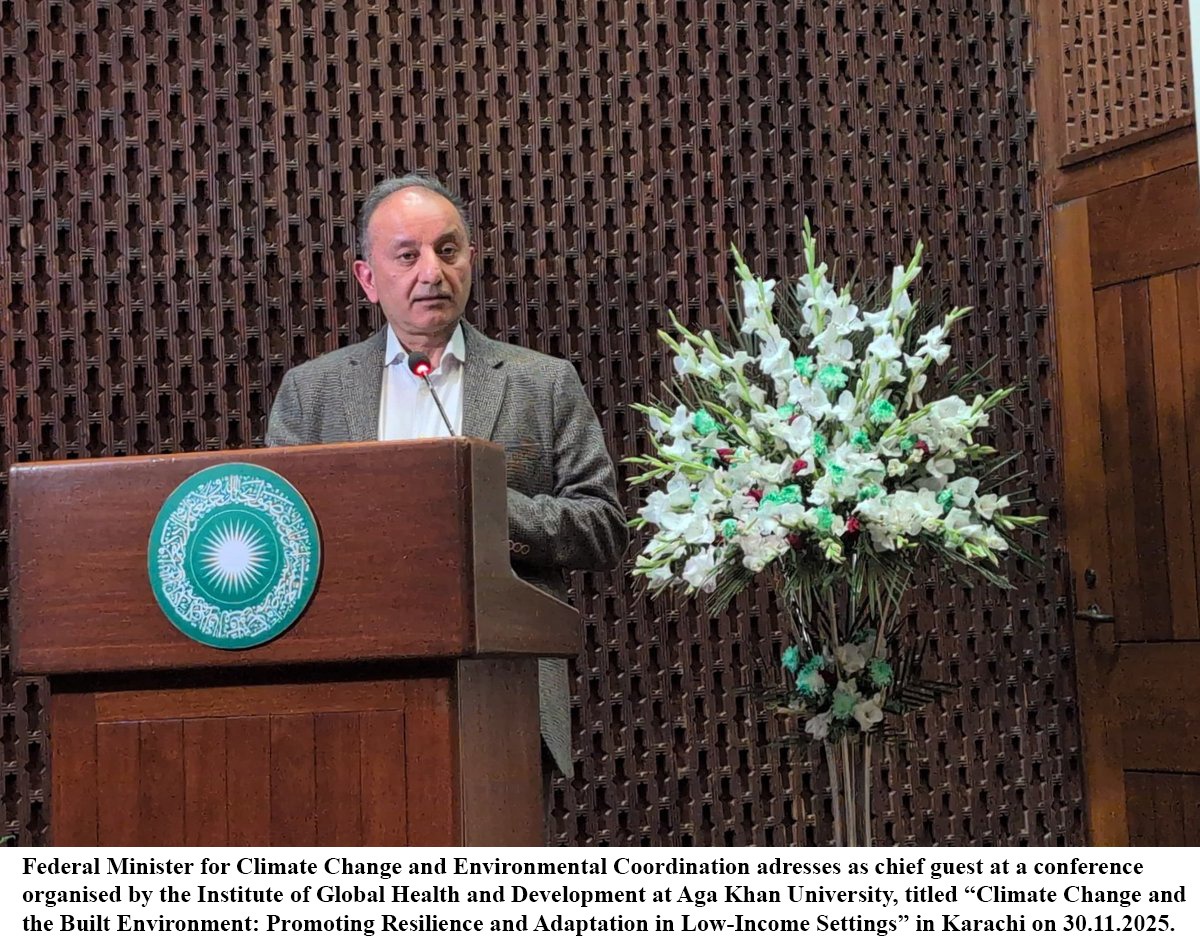
KARACHI (November 30, 2025) - Federal Minister for Climate Change and Environmental Coordination Dr Musadik Malik on Monday underlined the government’s accelerated efforts to strengthen climate resilience nationwide, announcing a comprehensive 300-day preparedness plan ahead of the 2026 monsoon season. Speaking as chief guest at a conference organised by the Institute of Global Health and Development at Aga Khan University, titled “Climate Change and the Built Environment: Promoting Resilience and Adaptation in Low-Income Settings”, Dr Malik said Pakistan could no longer delay urgent climate action as extreme weather events continue to escalate. He said the government was “fully cognizant” of the human, environmental and infrastructural risks posed by climate change and was taking coordinated steps to mitigate the impacts. The 300-day plan, developed on the prime minister’s instructions, focuses on restoring damaged infrastructure from this year’s floods and implementing immediate protective measures to reduce the severity of future disasters. “These coming 300 days are critical,” he told participants comprising experts, practitioners and policymakers. “We must rebuild what has been damaged and prepare ourselves for what is to come.” Dr Malik emphasised that climate resilience cannot be achieved without active participation from provincial governments, local institutions and community-based organisations. “Meaningful resilience is only possible when federal and provincial systems work together,” he said. Highlighting Pakistan’s disproportionate vulnerability, he reiterated that the country contributes less than one per cent to global greenhouse gas emissions yet remains among the most climate-impacted nations. In contrast, he said, ten countries are responsible for more than 70pc of global emissions. The minister reaffirmed Pakistan’s commitment to climate-resilient development and called on global partners, development institutions and local stakeholders to collaborate in building a sustainable and secure future for vulnerable communities.
Outlining the government’s phased strategy, he said Phase I centres on preparedness and restoration, while Phase II will scale up long-term adaptation initiatives already underway. The approach, he noted, reflects a broader vision: “Fix, Grow, and Build.”
He urged the international community to acknowledge its responsibility and strengthen support for climate justice, financing and transformative global action.
-----
For official communication or media-related inquiries, please contact: Muhammad Saleem Shaikh, Deputy Director (Media and Communication) Ministry of Climate Change and Environmental Coordination, Government of Pakistan at email: dd.media@mocc.gov.pk